viernes, 27 de abril de 2012

Acto de Yom Hashoá 5772

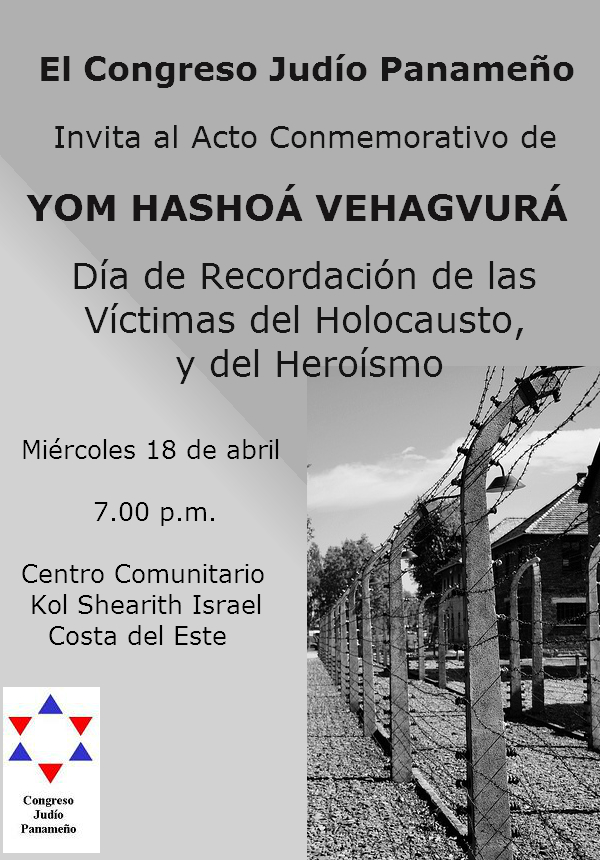
El pasado miércoles 18 de abril en la noche se realizo el Acto conmemorativo de Yom Hashoá Vehagvurá. La ceremonia organizada por el Congreso Judío Panameño contó con la presencia del Dr. Alexander Galilee, Embajador de Israel en Panamá.

Una nutrida asistencia se encontraba en el salón Melhado al dar inicio el acto con el encendido de las 6 velas recordatorias. El coro comunitario de KSI interpretó varias piezas alusivas a la jornada, entre ellas el Himno de los Partizanos.

El Embajador de Israel compartió las palabras que pronunciara ante el pleno de la Asamblea Nacional en enero pasado (ver discurso) y la señora Marianne Granat, sobreviviente de la Shoá, conmovió a los presentes con su testimonio (ver discurso).

El rabino Gustavo Kraselnik pronunció las plegarias de recordación. El acto concluyó con la entonación del Hatikva.

jueves, 26 de abril de 2012

Tazria - Metzorá 5772


Los rabinos de la UJCL escriben sobre la parasha

Rabina Daniela Szuster
Congregación Bnei Israel, San José-Costa Rica

Nuestra responsabilidad sobre la educación judía de nuestros jóvenes

 La primera parashá de esta semana, Parashat Tazría, nos ordena que cuando nace un hijo varón: "en el día octavo, habrá de ser circuncidada la carne de su prepucio" (Vaikrá 12:3). El Talmud nos enseña que esta es una de las tantas obligaciones de la familia para con sus hijos: "El padre está obligado de cuidar de que su hijo sea circuncidado, de redimirlo, de enseñarle la Torá, buscarle esposa y enseñarle un oficio. Algunos dicen que  debe enseñarle a nadar. Rabí Judá dice: quienquiera que no enseñe a su hijo un oficio, se considera que le ha enseñado a robar" (Talmud Babilónico, Tratado Kidushin 29a). Este pasaje talmúdico nos enseña que los progenitores debieran preocuparse de diferentes aspectos de la vida de sus hijos: 

"El padre está obligado de cuidar de que su hijo sea circuncidado…": como nuestro patriarca Abraham hizo con su hijo Itzjak, debemos también nosotros, por medio del ingreso al pacto, otorgarle una identidad, un legado de valores y forma de vida. "…de enseñarle la Torá…": dicen las fuentes (Lejem Mishné, Hiljot Talmud Torá 1:3)  que los progenitores mismos tienen que enseñarle, pero si no saben, pueden contratar a alguien experto para que lo haga en su lugar. Este pasaje nos indica acerca de la importancia de que nuestros hijos reciban educación judía. "…buscarle esposa…": se trata de la preocupación de los padres por la continuidad de la tradición, formando un hogar judío.  "…enseñarle un oficio…": con el fin de que pueda ser autónomo, independiente y abastecerse, tener una función, un trabajo digno; capacitarlos para desempeñarse en la vida laboral. "…enseñarle a nadar…": en la modernidad diríamos que es bueno para la salud y destreza corporal, sin embargo, los sabios se referían específicamente en caso que su hijo esté en el mar y esté en peligro, pueda salvar su vida.

Tazria-Metzorah 5772- English


Rabbi Daniela Szuster
B´nei Israel Congregation,
Costa Rica

Our Responsibility for our Young People’s Jewish Education

The first parashah of this week, Parashat Tazria, orders us that when a male child is born, “on the eighth day the flesh of his foreskin shall be circumcised” (Lev. 12:3).  The Talmud teaches us that this is one of the several obligations of the family towards its children:  “A father is obligated with respect to his son, to circumcise him, to redeem him if he is a firstborn, to teach him Torah, to take a wife for him and to teach him a craft. Some say: He is even obligated to teach him how to swim.”Rabbi Judah said: He who does not teach his son a craft… is as though he taught him to steal” (Babylonian Talmud, Tractate Kiddushin 29A).  This Talmudic passage teaches us that parents should be involved in different aspects of their children’s lives.

“A father is obligated with respect to his son, to circumcise him…”: as our patriarch Abraham did with Issac, we must do as well; through the entering into the covenant, give our children an identity, a legacy of values and way of life.  “… to teach him Torah…”: according to the sources (Lechem Mishneh, Hilkhot, Talmud Torah 1:3), the parents themselves must teach their children, but if they do not know, they may hire an expert to do it in their place.  This passage tells us about the importance of our children receiving a Jewish education.  “…to take a wife for him…”: this refers to the parent’s concern for the continuity of tradition, forming a Jewish home.  “…to teach him a craft…”: so that they can be self-sufficient, independent and able to support themselves, having a role, a worthy job; training them to manage in the working life.  “…to teach him how to swim…”: in modern times, we would say that this is healthy and strengthens the body; however, the sages specifically referred to the event of children at sea and when in danger, being able to save their lives.

jueves, 19 de abril de 2012

Mi Koré Ivrit? ¿Quién lee hebreo?

Esta semana dieron inicio las clases de hebreo para adultos (lectura nivel básico) en dos horarios diferentes (martes 11,00 a.m. y martes 6,30 p.m.)


Nuestros participantes comenzaron con las primeras letras que les permitan muy pronto poder leer

Aunque al principio parece un poco difíciles, ya pueden leer algunas palabras.

Todavía están a tiempo de sumarse esta próxima semana aquellos que se perdieron la primera clase!!!

Yom Haatzmaut en KSI


Sheminí 5772

Los Rabinos de la UJCL escriben sobre la parashá de la semana.
Rabino Joshua Kullock.
Comunidad Hebrea de Guadalajara, México.


El filósofo alemán Friedrich Nietzsche sostenía que no existen los hechos, sino solo interpretaciones. Asimismo, podemos afirmar que a mayor cantidad de interpretaciones de un hecho específico, mayores las posibilidades de que nadie sepa a ciencia cierta por qué sucedió lo que sucedió. Y para dar cuenta de todo esto, Nadav y Abihu bien pueden ser nuestros testigos.

Nuestra parashá comienza con la puesta en escena de una jornada memorable: al octavo día de haber inaugurado el Tabernáculo, luego de una semana de festejos dedicados a la ocasión, había llegado el momento de que el corazón del campamento de Israel comenzara a funcionar conforme a lo estipulado. Sin embargo, lo que era fiesta se transformó súbitamente en profunda tristeza: “Nadav y Abihu, hijos de Aarón, tomaron cada uno su incensario, pusieron en ellos fuego, le echaron incienso encima y ofrecieron delante de Ad-nai un fuego extraño, que no les había ordenado. Entonces salió de la presencia de Ad-nai un fuego que los quemó, y murieron delante de Ad-nai” (Lev. 10:1-2).

Shemini 5772 - English

Rabbi Joshua Kullock
Comunidad Hebrea de Guadalajara

The German philosopher Friedrich Nietzsche maintained that there are no facts, only interpretations. Likewise, we may affirm that the higher the number of interpretations concerning a specific event, the higher the possibilities that no one knows for sure why the event happened. And on this account, Nadab and Abihu can very well serve as our witnesses.

Our parashah begins with the staging of a memorable act:  on the eighth day following the Tabernacle’s inauguration, after a week of celebrating the occasion, the time has finally come for the heart of Israel’s camp to start working according to stipulations.  Nevertheless, what was a joyful celebration suddenly fell deep into sadness:  “Now Aaron's sons Nadab and Abihu each took his fire pan, put fire in it, and laid incense on it; and they offered before the Lord alien fire, which He had not enjoined upon them.  And fire came forth from the Lord and consumed them; thus they died at the instance of the Lord” (Lev. 10:1-2).

lunes, 16 de abril de 2012

jueves, 12 de abril de 2012

Servicios Religiosos - últimos días de Pesaj 5772

Séptimo día de Pesaj

Arvit:                          Jueves 12 de abril a las 6:30 p.m.
Shajarit:                      Viernes 13 de abril a las 9:00 a.m.

Octavo día de Pesaj (Shabat)

Kabalt Shabat y Arvit:   Viernes 13 de Abril a las 6:30 p.m.
Shajarit*:                   Sábado 14 de abril a las 9:00 a.m.

* Incluye el recitado de Izkor (Servicio de Recordación)

Pesach - 8° day

Rabbi Claudio Jodorkovsky.
Asociación Israelita Montefiore - Bogota

The end of Pesach…  We leave behind the Sederim and start to say goodbye to this beautiful family celebration which, year after year, summons us to rescue the legacy that we, as Jews, inherit from our millennial history.  And I would like to share with you something that happened to me a few years ago, that I believe may help us as a reflection for these last two days of the festival.

Once, a member of my community called me a few days after Pesach, to share with me his joy for having made the effort and devoted himself, for the first time, to keeping the laws relating to the festivity.  He told me that he, together with his family, had carried out the hagallah (preparation of the utensils and pots to make them appropriate for Pesach), performed the cleaning and elimination of the chametz, and even struggled to not consume products without rabbinical supervision.  He was clearly proud of what they had achieved.  And when he finished telling me, he asked me the following question:  “Rabbi, how can it be that the festival where we celebrate freedom is also the one with more restrictions and laws?”